The Rule of Law & the British Accreditation Regency (B.A.R.)

I AM ALL I AM

Active member
Joined
Jan 29, 2022
Messages
232
Reaction score
45
Points
28
G'day.

This post is a kick-start for this topic, which I will be adding further details in later posts.

This will include (though not limited to);

- The 12 Etruscan City States from which Rome and precedence in law originated.
- The 12 Tables of Roman Law.
- Corpus Juris Civilis.
- The difference between 'Possession' and 'Ownership' in Roman Law.
- Information about the 'Strawman' and how it affects you.

Remember, it is the 'Rulers' that make the 'Rules'. So if you do not know where the 'Rules' have come from, then you do not know who the 'Rulers' are.

How To Defeat Admiralty Courts And “The Law Of The See”​

May 13, 2013

Admiralty


Judge Dale, Ret’d – The Catholic word “See” conceals the influence of the Holy Roman Church over the corrupt corporate government and legal system.

The term “see” comes from the Latin word “sedes”, meaning “seat”, which refers to the Episcopal throne (cathedra).

The term “Apostolic See” can refer to any see founded by one of the Apostles, but, when used with the definite article, it is used in the Catholic Church to refer specifically to the see of the Bishop of Rome, whom that Church sees as successor of Saint Peter, the Prince of the Apostles.[22] http://en.wikipedia.org/wiki/Holy_See

Sedes Sacrorum (Latin Sedes for seat/see, Sacrorum for holy) otherwise known as Santa Sede and the “SS” also known in English as “Holy See” refers to the legal apparatus as a whole by which the Roman Catholic Pope and its Curia of Bishops claim historical recognition as a sovereign entity with superior legal rights. (http://one-evil.org/content/entities_organizations_holy_see.html)

The Catholic Church uses two legal personalities with which to conduct its international affairs: the first is as an International state known as the Vatican City State, to which the Pope is the Head of Government. The second is as the supreme legal personality above all other legal personalities by which all property and “creatures” are subjects.

The legal enforcability of its first personality as an International State is constrained by international law. The sovereign status of the Vatican City remains dependent upon the continued recognition of an agreement known as the “Lateran Treaty” signed between Catholic Facist Dictator and . . . Benito Mussolini in 1929 and his political supporter Pope Pius XI. This recognition remains in defiance and contempt to existing international laws prohibiting recognition of rogue states and laws created by mass murdering dictators.

The legal enforcability of the second personality of the Catholic Church as the Holy See is dependent upon the continued adherence to legal statutes, definitions, conventions and covenants as have been accumulated since the Middle Ages concerning the primacy of the Pope over all property and creatures. These statutes, conventions and covenants remain the fabric and foundation of the modern legal system of most states in the world.

To extend its legal strength using its second personality, the Catholic Church considers the region controlled by every bishop a See.

Admiralty Law​

Admiralty law was introduced into England by the French Queen Eleanor of Aquitaine while she was acting as regent for her son, King Richard the Lionheart. She had earlier established admiralty law on the island of Oleron (where it was published as the Rolls of Oleron) in her own lands (although she is often referred to in admiralty law books as “Eleanor of Guyenne”), having learned about it in the eastern Mediterranean while on a Crusade with her first husband, King Louis VII of France. In England, special admiralty courts handle all admiralty cases. These courts do not use the common law of England, but are civil law courts largely based upon the Corpus Juris Civilis of Justinian.

Admiralty courts were a prominent feature in the prelude to the American Revolution. For example, the phrase in the Declaration of Independence “For depriving us in many cases, of the benefits of Trial by Jury” refers to the practice of Parliament giving the Admiralty Courts jurisdiction to enforce The Stamp Act in the American Colonies.[4] Because the Stamp Act was unpopular, a colonial jury was unlikely to convict a colonist of its violation. However, because admiralty courts did not (as is true today) grant trial by jury, a colonist accused of violating the Stamp Act could be more easily convicted by the Crown.

Admiralty law became part of the law of the United States as it was gradually introduced through admiralty cases arising after the adoption of the U.S. Constitution in 1789. Many American lawyers who were prominent in the American Revolution were admiralty and maritime lawyers in their private lives. Those included are Alexander Hamilton in New York and John Adams in Massachusetts.

In 1787 John Adams, who was then ambassador to France, wrote to James Madison proposing that the U.S. Constitution, then under consideration by the States, be amended to include “trial by jury in all matters of fact triable by the laws of the land [as opposed the law of admiralty] and not by the laws of Nations [i.e. not by the law of admiralty]”. The result was the Seventh Amendment to the U.S. Constitution. Alexander Hamilton and John Adams were both admiralty lawyers and Adams represented John Hancock in an admiralty case in colonial Boston involving seizure of one of Hancock’s ships for violations of Customs regulations. In the more modern era, Supreme Court Justice Oliver Wendell Holmes was an admiralty lawyer before ascending to the federal bench. http://en.wikipedia.org/wiki/Admiralty_law

The Roman Court is very confusing – even for some judges – because it does not operate according to any true set rules of law but rather by presumptions of law. If these presumptions presented by the Private Bar Guild (BAR attorneys) are not rebutted they become fact and thereafter are said to stand as a “Truth in Commerce.” Despite the façade, the world is a playground of commercial business and is secretly owned by private foreign corporations.

Why is the Bar Guild so hell-bent on keeping everything on the private side? Because the public side invokes constitutional issues and nothing they do can withstand a constitutional challenge. The organic Constitution still exists in its original glory and authority and is buried in the US Printing Office.

All amendments since 1871 do not exist. Why? It was the “corporate mission statement” for the District of Columbia that was written in 1871 to resemble the organic Constitution. It is that corporate mission statement that has been amended since 1871 and chopped up as of late.

A Legal Way To Defeat This System​

Specifically, there is a defendant living in Florida who discovered the answer to this puzzle and properly embraced his (all caps name / strawman) by registering it as a “Fictitious Name” with the state of Florida.

This process identified him as having a commercial and intellectual proprietary interest in the (all caps name). He, by entering it as such clearly on the Public Record, successfully rebutted all (12) presumptions on the private side of the Admiralty Court and nullified its “jurisdiction.”

What did he do?​

The Registration of a Fictitious Name is something you might do if you wanted to open a commercial business and you wanted to reserve a “creative name” to identify that business. The process, however, does not obligate you to ever open a business or to incorporate. It simply reserves the name for your future use and as your commercial and intellectual proprietary property.

For many years patriots have attempted to disassociate their sovereign beings from the legal fiction – the all caps name / strawman – created by the corporate government because this was designed to make you personally vulnerable and convert your living being into a corporation – a thing – and the property of the corporate government.

Certain patriots properly decided to embrace the corporate fiction / strawman as their own personal property by affidavit using a Financing Statement filed under the UCC (Uniform Commercial Code) as a notice to the world. This is because an unrebutted affidavit stands as Truth in Commerce and the government never rebuts these affidavits.

So why didn’t it work?

The patriots bypassed one crucial step. They failed to rebut the presumptions of the private side of the corporate government and courts that imprisoned their sweat equity and labor.

An unrebutted presumption stands as Truth in Commerce. Their presumption nullified the affidavit and placed them on the private side.
There are twelve (12) key presumptions asserted by the Private Bar Guilds, which, if left unchallenged, stand as Truth in Commerce.

These are:
  • The Public Record
  • Public Service
  • Public Oath
  • Immunity
  • Summons
  • Custody
  • Court of Guardians
  • Court of Trustees
  • Government as Executor/Beneficiary
  • Executor De Son Tort (not a party to)
  • Incompetence
  • Guilt
I’m only going to discuss (6) of those (12) presumptions. However, Frank O’Collins did a superb job addressing these presumptions in an expose’ titledA history of today’s slavery and I encourage you all to read it.

Canon 3228 (i): The Presumption Of Public Record​

Any matter brought before a lower Roman Court is a matter for the public record, when in fact it is presumed by the Private Bar Guild as private business. Unless this presumption is openly rebutted by filing or stating clearly on the Public Record that the matter is to be a part of the Public Record, the matter remains on the private side as private Bar Guild business under private Guild rules.

The defendant in this particular case recorded on the Public Record the Registration Certificate issued by the state of Florida, identifying his registered ownership of the fictitious (all caps name), which proved that he was not the alleged defendant on the Courts Docket. I believe I should refer to him as the alleged defendant from here on.

Canon 3228 (ii), (iii) and (iv): The Presumptions Of Public Service; Oath And Immunity.​

If the Judge ignores the alleged defendants Fictitious Name Registration entered into the Public Record, which is clearly presented to him in open Court and then decides to move forward with the case, he violates his public service oath and judicial immunity under these sub-sections.

Canon 3228 (v): The Presumption Of Summons​

A summons, when unrebutted, stands as Truth in Commerce. Attendance in a Court is usually invoked by invitation and therefore one who attends Court initiated by a summons, warrant, subpoena or replevin bond, is presumed to accept the position of a (defendant, juror, witness or thing) and the (jurisdiction) of the Court.

If these instruments are not rejected and returned, with a copy of the rejection filed clearly on the Public Record (jurisdiction) the presumed position and the presumption of guilt also stands as Truth in Commerce.

In this particular case the alleged defendant rebutted his forced appearance by presenting the Judge with the recorded registration certificate issued by Florida. This certificate stated he is not the defendant on the courts docket. ‘The name is fictitious and I am the registered owner of that name under Florida law.’

Canon 3228 (vi): The Presumption Of Custody​

Those who attend a Court initiated pursuant to the command of a summons or warrant, is presumed to be “corporate property or a thing” and therefore is liable to be detained in custody by the Courts appointed or elected “Custodian.”

Custodians may only retain custody over “property and things” and not flesh and blood living beings. Unless this presumption is openly challenged by rejection of the summons or warrant on the Public Record, the presumption stands as Truth in Commerce and you are thereafter treated as a “thing or property.”

In this particular case this presumption was absolutely rebutted when the alleged defendant proved his arrest was a case of mistaken identity and in no way could the Court Custodian detain him after that.

Sixteen words written across the face of the summons or warrant; notarized and filed on the Public Record will cure most problems. Those words are:

I do not accept this offer to contract and I do not consent to these proceedings.

In addition to the above sections of Canon Law 3228, the defendant has also unknowingly rebutted the balance of the (12) presumptions:
  • Court Guardians
  • Court Trustees
  • Government as Executor and Beneficiary
  • Executor De Son Tort (not a party to)
  • Incompetence
  • Guilt
This particular defendant succeeded in accomplishing all of this by “registering” his ALL CAPS name as a “Fictitious Name” in which only he now owns an absolute commercial and intellectual proprietary interest in the state of Florida. By entering it in the (Public Record) he has overcome all (12) presumptions and nullified the “prosecution and jurisdiction” of the private Roman court. His next step would be to record it in the UCC, which is a notice to the world.

Checkmate.​

There is no way for the corporate government and private Roman Court to proceed against this living being. If the prosecutor was to disclose the presumptive frauds that the Court has been operating under in the private side, it would also nullify the case and subject the judge to arrest and damages for “prosecutorial fraud” and the “absence of jurisdiction.”

Please note that the judge’s only legal response to the alleged defendant is to Order a “Stay” until the defendant secures counsel (meaning an attorney and BAR Guild member). If it is reported that the alleged defendant has not secured counsel the case remains absolutely deadlocked! If this open “stay” does not cause him any harm (and it shouldn’t) he can choose to
  • do nothing or
  • he can file a two page “Motion to Dismiss” or
  • he can file a “Rule to Show Cause” seeking a summary judgment for damages on behalf of his living being.
What would happen if the individual follows the judge’s advice and hires an attorney? In all probability his attorney would use the alleged defendant’s “signed power of attorney” to withdraw the “Fictitious Name Registration” from the Public Record. The defendant would more than likely be imprisoned, tried on the private side, and convicted!

What other applications can this process be used for?
  • licensing
  • tax collections
  • foreclosures
  • debt collections
  • the vehicle code, to name a few.
All of these matters are found on the private side and none could withstand a Constitutional challenge.

Again, checkmate! (Don’t you just love a good story with a happy ending?)

Shift Frequency May 13 2013
 

I AM ALL I AM

Active member
Joined
Jan 29, 2022
Messages
232
Reaction score
45
Points
28

Formal Challenge to the
Twelve Presumptions of L
aw

Definition of presumption:
Code:
http://www.oxforddictionaries.com/definition/english/presumption

1. An idea that is taken to be true on the basis of probability:

As a presumption, is a presumption on which must be agreed by the parties, to be true. THEN and EQUALY

If one party challenges the presumption to be true on the basis of probability, then all that is required to remove the presumption is a formal challenge to that presumption. The presumption then, has no standing or merit in FACT.

A probability:
Code:
http://www.oxforddictionaries.com/definition/american_english/probability

1. The extent to which something is probable; the likelihood of something happening or being the case.

By definition then, this is not substantive as it is only a probability of what may be and therefore has NO substance, in material FACT.

A State Court does not operate according to any true rule of law, but by presumptions (colour) of the law. Therefore, if presumptions presented by the private Bar Guild are not rebutted, they become fact and are therefore said to stand true. There are twelve (12) key presumptions asserted by the private Bar Guilds which if unchallenged stand true, being Public Record, Public Service, Public Oath, Immunity, Summons, Custody, Court of Guardians, Court of Trustees, Government as Executor/Beneficiary, Agent and Agency, Incompetence, and Guilt:

(i) The Presumption of Public Record is that any matter brought before a state Court is a matter for the public record when in fact it is presumed by the members of the private Bar Guild that the matter is a private Bar Guild business matter. Unless openly rebuked and rejected by stating clearly the matter is to be on the Public Record, the matter remains a private Bar Guild matter, completely under private Bar Guild rules;

I, John Smith, the undersigned formally challenge the Presumption of Public Record as it is by definition a presumption and has no standing or merit in presentable or material fact.

(ii) The Presumption of Public Service is that all the members of the Private Bar Guild who have all sworn a solemn secret absolute oath to their Guild then act as public agents of the Government, or “public officials” by making additional oaths of public office that openly and deliberately contradict their private "superior" oaths to their own Guild. Unless openly rebuked and rejected, the claim stands that these private Bar Guild members are legitimate public servants and therefore trustees under public oath;

I, John Smith, the undersigned formally challenge the Presumption of Public Service as it is by definition a presumption and has no standing or merit in presentable or material fact.

(iii) The Presumption of Public Oath is that all members of the Private Bar Guild acting in the capacity of "public officials" who have sworn a solemn public oath, remain bound by that oath and therefore bound to serve honestly, impartiality and fairly as dictated by their oath. Unless openly challenged and demanded, the presumption stands that the Private Bar Guild members have functioned under their public oath in contradiction to their Guild oath. If challenged, such individuals MUST recuse themselves as having a conflict of interest and cannot possibly stand under a public oath;

I, John Smith, the undersigned formally challenge the Presumption of Public Oath as it is by definition a presumption, by definition and has no standing or merit in presentable or material fact.

(iv) The Presumption of Immunity is that key members of the Private Bar Guild in the capacity of "public officials" acting as judges, prosecutors and magistrates who have sworn a solemn public oath in good faith are immune from personal claims of injury and liability. Unless openly challenged and their oath demanded, the presumption stands that the members of the Private Bar Guild as public trustees acting as judges, prosecutors and magistrates are immune from any personal accountability for their actions;

I, John Smith, the undersigned formally challenge the Presumption of Immunity as it is by definition a presumption, by definition and has no standing or merit in presentable or material fact.

(v) The Presumption of Summons is that by custom a summons unrebutted stands and therefore one who attends Court is presumed to accept a position (defendant, juror, witness) and jurisdiction of the court. Attendance to court is usually invitation by summons. Unless the summons is rejected and returned, with a copy of the rejection filed prior to choosing to visit or attend, jurisdiction and position as the accused and the existence of "guilt" stands;

I, John Smith, the undersigned formally challenge the Presumption of Summons as it is by definition a presumption, by definition and has no standing or merit in presentable or material fact.

(vi) The Presumption of Custody is that by custom a summons or warrant for arrest unrebutted stands and therefore one who attends Court is presumed to be a thing and therefore liable to be detained in custody by "Custodians". Custodians may only lawfully hold custody of property and "things" not flesh and blood soul possessing beings. Unless this presumption is openly challenged by rejection of summons and/or at court, the presumption stands you are a thing and property and therefore lawfully able to be kept in custody by custodians;

I, John Smith, the undersigned formally challenge the Presumption of Custody as it is by definition a presumption, by definition and has no standing or merit in presentable or material fact.

(vii) The Presumption of Court of Guardians is the presumption that as you may be listed as a "resident" of a ward of a local government area and have listed on your "passport" the letter P, you are a pauper and therefore under the "Guardian" powers of the government and its agents as a "Court of Guardians". Unless this presumption is openly challenged to demonstrate you are both a general guardian and general executor of the matter (trust) before the court, the presumption stands and you are by default a pauper, and lunatic and therefore must obey the rules of the clerk of guardians (clerk of magistrates court);

I, John Smith, the undersigned formally challenge the Presumption of Guardians as it is by definition a presumption, by definition and has no standing or merit in presentable or material fact.

(viii) The Presumption of Court of Trustees is that members of the Private Bar Guild presume you accept the office of trustee as a "public servant" and "government employee" just by attending a Roman Court, as such Courts are always for public trustees by the rules of the Guild and the Roman System. Unless this presumption is openly challenged to state you are merely visiting by "invitation" to clear up the matter and you are not a government employee or public trustee in this instance, the presumption stands and is assumed as one of the most significant reasons to claim jurisdiction - simply because you "appeared";

I, John Smith, the undersigned formally challenge the Presumption of Trustees as it is by definition a presumption, by definition and has no standing or merit in presentable or material fact.

(ix) The Presumption of Government acting in two roles as Executor and Beneficiary is that for the matter at hand, the Private Bar Guild appoints the judge/magistrate in the capacity of Executor while the Prosecutor acts in the capacity of Beneficiary of the trust for the current matter. If the accused does seek to assert their right as Executor and Beneficiary over their body, mind and soul they are acting as an Executor De Son Tort or a "false executor" challenging the "rightful" judge as Executor.

Therefore, the judge/magistrate assumes the role of "true" executor and has the right to have you arrested, detained, fined or forced into a psychiatric evaluation. Unless this presumption is openly challenged to demonstrate you are both the true general guardian and general executor of the matter (trust) before the court, questioning and challenging whether the judge or magistrate is seeking to act as Executor De Son Tort, the presumption stands and you are by default the trustee, therefore must obey the rules of the executor (judge/magistrate) or you are an Executor De Son Tort and a judge or magistrate of the private Bar guild may seek the assistance of bailiffs or sheriffs to assert their false claim against you;

I, John Smith, the undersigned formally challenge the Presumption of Government acting in two roles as Executor and Beneficiary as it is by definition a presumption, by definition and has no standing or merit in presentable or material fact.

(x) The Presumption of Agent and Agency is the presumption that under contract law you have expressed and granted authority to the Judge and Magistrate through the statement of such words as "recognise, understand" or "comprehend" and therefore agree to be bound to a contract. Therefore, unless all presumptions of agent appointment are rebutted through the use of such formal rejections as "I do not recognise you", to remove all implied or expressed appointment of the judge, prosecutor or clerk as agents, the presumption stands and you agree to be contractually bound to perform at the direction of the judge or magistrate;

I, John Smith, the undersigned formally challenge the Presumption of Agent and Agency as it is by definition a presumption, by definition and has no standing or merit in presentable or material fact.

(xi) The Presumption of Incompetence is the presumption that you are at least ignorant of the law, therefore incompetent to present yourself and argue properly. Therefore, the judge/magistrate as executor has the right to have you arrested, detained, fined or forced into a psychiatric evaluation. Unless this presumption is openly challenged to the fact that you know your position as executor and beneficiary and actively rebuke and object to any contrary presumptions, then it stands by the time of pleading that you are incompetent then the judge or magistrate can do what they need to keep you obedient.

I, John Smith, the undersigned formally challenge the Presumption of Incompetence as it is by definition a presumption, by definition and has no standing or merit in presentable or material fact.

(xii) The Presumption of Guilt is the presumption that as it is presumed to be a private business meeting of the Bar Guild, you are guilty whether you plead "guilty", do not plead or plead "not guilty". Therefore unless you either have previously prepared an affidavit of truth and motion to dismiss with extreme prejudice onto the public record or call a demurrer, then the presumption is you are guilty and the private Bar Guild can hold you until a bond is prepared to guarantee the amount the guild wants to profit from you.

I, John Smith, the undersigned formally challenge the Presumption of Guilt as it is by definition a presumption, by definition and has no standing or merit in presentable or material fact.

I formally challenge all presumptions of law and as I have formally challenged all the twelve presumptions of law then the presumption of law formally has no substance in material FACT.

I will recognise the rule of law, when and only when there is the material evidence of, that assumed rule of law has some material evidence of substance in presentable material fact.

Until then, the search for the rule of law, that has some credibility in material fact: continues.


It is done.
Without ill will or vexation

..........................................................
John Smith
For and on behalf of the Legal Entity MR JOHN SMITH and the living man, John Smith.
 

I AM ALL I AM

Active member
Joined
Jan 29, 2022
Messages
232
Reaction score
45
Points
28

Colonel Edward Mandell House Predicts the Creation of the STRAWMAN in the United States.

This is the first real evidence found that our current Social, Financial, and Legal system was deliberately designed to enslave humanity:

In a private meeting with Woodrow Wilson (US President 1913 - 1921) Colonel Edward Mandell House predicted the banksters' plans to enslave the American people. He stated:

"Very soon, every American will be required to register their biological property (that's you and your children) in a national system designed to keep track of the people and that will operate under the ancient system of pledging. By such methodology, we can compel people to submit to our agenda, which will affect our security as a charge back for our fiat paper currency.

"Every American will be forced to register or suffer being able to work and earn a living. They will be our chattels (property) and we will hold the security interest over them forever, by operation of the law merchant under the scheme of secured transactions. Americans, by unknowingly or unwittingly delivering the bills of lading (Birth Certificate) to us will be rendered bankrupt and insolvent, secured by their pledges.

"They will be stripped of their rights and given a commercial value designed to make us a profit and they will be none the wiser, for not one man in a million could ever figure our plans and, if by accident one or two should figure it out, we have in our arsenal plausible deniability. After all, this is the only logical way to fund government, by floating liens and debts to the registrants in the form of benefits and privileges.

"This will inevitably reap us huge profits beyond our wildest expectations and leave every American a contributor to this fraud, which we will call “Social Insurance.” Without realizing it, every American will unknowingly be our servant, however begrudgingly. The people will become helpless and without any hope for their redemption and we will employ the high office (presidency) of our dummy corporation (USA) to foment this plot against America."

- Colonel Edward Mandell House
 

I AM ALL I AM

Active member
Joined
Jan 29, 2022
Messages
232
Reaction score
45
Points
28
The Etruscans adopted the city-state as their political unit from the Greeks, earlier than their neighbours in central Italy. The Etruscan homeland was originally divided into twelve city-states, but new cities sprang up as the Etruscans expanded their sphere of influence.
www.timemaps.com/civilizations/etruscans/


The historical Etruscans had achieved a state system of society, with remnants of the chiefdom and tribal forms. In this, they were different from the surrounding Italics, who had chiefs and tribes.[citation needed] Rome was in a sense the first Italic state, but it began as an Etruscan one. It is believed that the Etruscan government style changed from total monarchy to oligarchic republic (as the Roman Republic) in the 6th century BC, although it is important to note this did not happen to all the city-states.[citation needed]

The government was viewed as being a central authority, ruling over all tribal and clan organizations. It retained the power of life and death; in fact, the gorgon, an ancient symbol of that power, appears as a motif in Etruscan decoration. The adherents to this state power were united by a common religion. Political unity in Etruscan society was the city-state, which was probably the referent of methlum, "district". Etruscan texts name quite a number of magistrates, without much of a hint as to their function: The camthi, the parnich, the purth, the tamera, the macstrev, and so on. The people were the mech. The chief ruler of a methlum was perhaps a zilach.[citation needed]
en.wikipedia.org/wiki/Etruscan_civilization


According to legend,[67] there was a period between 600 BC and 500 BC in which an alliance was formed among twelve Etruscan settlements, known today as the Etruscan League, Etruscan Federation, or Dodecapolis (in Greek Δωδεκάπολις). According to a legend the Etruscan League of twelve cities was founded by Tarchon and his brother Tyrrhenus. Tarchon lent his name to the city of Tarchna, or Tarquinnii, as it was known by the Romans. Tyrrhenus gave his name to the Tyrrhenians, the alternative name for the Etruscans. Although there is no consensus on which cities were in the league, the following list may be close to the mark: Arretium, Caisra, Clevsin, Curtun, Perusna, Pupluna, Veii, Tarchna, Vetluna, Volterra, Velzna, and Velch. Some modern authors include Rusellae.[68] The league was mostly an economic and religious league, or a loose confederation, similar to the Greek states.
en.wikipedia.org/wiki/Etruscan_civilization#Possible_founding_of_Rome


Roman citizenship​

Citizenship in ancient Rome (Latin: civitas) was a privileged political and legal status afforded to free individuals with respect to laws, property, and governance.
.....
Roman citizenship was also used as a tool of foreign policy and control. Colonies and political allies would be granted a "minor" form of Roman citizenship, there being several graduated levels of citizenship and legal rights (the Latin Right was one of them). The promise of improved status within the Roman "sphere of influence", and the rivalry with one's neighbours for status, kept the focus of many of Rome's neighbours and allies centered on the status quo of Roman culture, rather than trying to subvert or overthrow Rome's influence.

The granting of citizenship to allies and the conquered was a vital step
in the process of Romanization. This step was one of the most effective political tools and (at that point in history) original political ideas.

Previously Alexander the Great had tried to "mingle" his Greeks with the Persians, Egyptians, Syrians, etc. in order to assimilate the people of the conquered Persian Empire, but after his death this policy was largely ignored by his successors.

The idea was not to assimilate, but to turn a defeated and potentially rebellious enemy (or their sons) into Roman citizens. Instead of having to wait for the unavoidable revolt of a conquered people (a tribe or a city-state) like Sparta and the conquered Helots, Rome tried to make those under its rule feel that they had a stake in the system.
en.wikipedia.org/wiki/Roman_citizenship

Roman law​

Roman law is the legal system of ancient Rome, including the legal developments spanning over a thousand years of jurisprudence, from the Twelve Tables (c. 449 BC), to the Corpus Juris Civilis (AD 529) ordered by Eastern Roman emperor Justinian I. Roman law forms the basic framework for civil law, the most widely used legal system today, and the terms are sometimes used synonymously. The historical importance of Roman law is reflected by the continued use of Latin legal terminology in many legal systems influenced by it, including common law.

After the dissolution of the Western Roman Empire, the Roman law remained in effect in the Eastern Roman Empire. From the 7th century onward, the legal language in the East was Greek.

Roman law also denoted the legal system applied in most of Western Europe until the end of the 18th century. In Germany, Roman law practice remained in place longer under the Holy Roman Empire (963–1806). Roman law thus served as a basis for legal practice throughout Western continental Europe, as well as in most former colonies of these European nations, including Latin America, and also in Ethiopia. English and Anglo-American common law were influenced also by Roman law, notably in their Latinate legal glossary (for example, stare decisis, culpa in contrahendo, pacta sunt servanda).[1] Eastern Europe was also influenced by the jurisprudence of the Corpus Juris Civilis, especially in countries such as medieval Romania (Wallachia, Moldavia, and some other medieval provinces/historical regions) which created a new system, a mixture of Roman and local law. Also, Eastern European law was influenced by the "Farmer's Law" of the medieval Byzantine legal system.

Development

Before the Twelve Tables (754–449 BC), private law comprised the Roman civil law (ius civile Quiritium) that applied only to Roman citizens, and was bonded to religion; undeveloped, with attributes of strict formalism, symbolism, and conservatism, e.g. the ritual practice of mancipatio (a form of sale). The jurist Sextus Pomponius said, "At the beginning of our city, the people began their first activities without any fixed law, and without any fixed rights: all things were ruled despotically, by kings".[2] It is believed that Roman Law is rooted in the Etruscan religion, emphasizing ritual.[3]

Twelve Tables​

The first legal text is the Law of the Twelve Tables, dating from the mid-fifth century BC. The plebeian tribune, C. Terentilius Arsa, proposed that the law should be written in order to prevent magistrates from applying the law arbitrarily.[4] After eight years of political struggle, the plebeian social class convinced the patricians to send a delegation to Athens to copy the Laws of Solon; they also dispatched delegations to other Greek cities for a like reason.[4] In 451 BC, according to the traditional story (as Livy tells it), ten Roman citizens were chosen to record the laws, known as the decemviri legibus scribundis. While they were performing this task, they were given supreme political power (imperium), whereas the power of the magistrates was restricted.[4] In 450 BC, the decemviri produced the laws on ten tablets (tabulae), but these laws were regarded as unsatisfactory by the plebeians. A second decemvirate is said to have added two further tablets in 449 BC. The new Law of the Twelve Tables was approved by the people's assembly.[4]
.....
Traditionally, the origins of Roman legal science are connected to Gnaeus Flavius. Flavius is said to have published around the year 300 BC the formularies containing the words which had to be spoken in court to begin a legal action. Before the time of Flavius, these formularies are said to have been secret and known only to the priests.
.....

Legacy

German legal theorist Rudolf von Jhering famously remarked that ancient Rome had conquered the world three times: the first through its armies, the second through its religion, the third through its laws. He might have added: each time more thoroughly.
— David Graeber, Debt: The First 5,000 Years
.....
en.wikipedia.org/wiki/Roman_law


The word gens is sometimes translated as "race", or "nation", meaning a people descended from a common ancestor (rather than sharing a common physical trait). It can also be translated as "clan", "kin", or "tribe", although the word tribus has a separate and distinct meaning in Roman culture. A gens could be as small as a single family, or could include hundreds of individuals. According to tradition, in 479 BC the gens Fabia alone were able to field a militia consisting of three hundred and six men of fighting age. The concept of the gens was not uniquely Roman, but was shared with communities throughout Italy, including those who spoke Italic languages such as Latin, Oscan, and Umbrian as well as the Etruscans
en.wikipedia.org/wiki/Gens
 

I AM ALL I AM

Active member
Joined
Jan 29, 2022
Messages
232
Reaction score
45
Points
28
Roman Naming conventions

Over the course of some fourteen centuries, the Romans and other peoples of Italy employed a system of nomenclature that differed from that used by other cultures of Europe and the Mediterranean Sea, consisting of a combination of personal and family names. Although conventionally referred to as the tria nomina, the combination of praenomen, nomen, and cognomen that have come to be regarded as the basic elements of the Roman name in fact represent a continuous process of development, from at least the seventh century BC to the end of the seventh century AD. The names that developed as part of this system became a defining characteristic of Roman civilization, and although the system itself vanished during the Early Middle Ages, the names themselves exerted a profound influence on the development of European naming practices, and many continue to survive in modern languages.

Overview

The distinguishing feature of Roman nomenclature was the use of both personal names and regular surnames. Throughout Europe and the Mediterranean, other ancient civilizations distinguished individuals through the use of single personal names, usually dithematic in nature. Consisting of two distinct elements, or "themes", these names allowed for hundreds or even thousands of possible combinations. But a markedly different system of nomenclature arose in Italy, where the personal name was joined by a hereditary surname. Over time, this binomial system expanded to include additional names and designations.[1][2]

The most important of these names was the nomen gentilicium, or simply nomen, a hereditary surname that identified a person as a member of a distinct gens. This was preceded by the praenomen, or "forename", a personal name that served to distinguish between the different members of a family. For example, a Roman named Publius Lemonius might have sons named Publius, Lucius, and Gaius Lemonius. Here, Lemonius is the nomen, identifying each person in the family as a member of the gens Lemonia; Publius, Lucius, and Gaius are praenomina used to distinguish between them.[1]

The origin of this binomial system is lost in prehistory, but it appears to have been established in Latium and Etruria by at least 650 BC.[2] In written form, the nomen was usually followed by a filiation, indicating the personal name of an individual's father, and sometimes the name of the mother or other antecedents. Toward the end of the Roman Republic, this was followed by the name of a citizen's voting tribe. Lastly, these elements could be followed by additional surnames, or cognomina, which could be either personal or hereditary, or a combination of both.[1]
.....

The development of the nomen as the second element of the Italic name cannot be attributed to a specific period or culture. From the earliest period it was common to both the Indo-European speaking Italic peoples and the Etruscans.
.....

Praenomen

The praenomen was a true personal name, chosen by a child's parents, and bestowed on the dies lustricius, or "day of lustration", a ritual purification performed on the eighth day after the birth of a girl, or the ninth day after the birth of a boy.[iv
.....

Nomen

The nomen gentilicium, or "gentile name",[vii] designated a Roman citizen as a member of a gens. A gens, which may be translated as "race", "family", or "clan", constituted an extended Roman family, all of whom shared the same nomen, and claimed descent from a common ancestor. Particularly in the early Republic, the gens functioned as a state within the state, observing its own sacred rites, and establishing private laws, which were binding on its members, although not on the community as a whole.[10]

Cognomen

The cognomen, the third element of the tria nomina, began as an additional personal name.
.....

Tribe

From the beginning of the Roman Republic, all citizens were enumerated in one of the tribes making up the comitia tributa, or "tribal assembly". This was the most democratic of Rome's three main legislative assemblies of the Roman Republic, in that all citizens could participate on an equal basis, without regard to wealth or social status. Over time, its decrees (known as plebi scita, or "plebiscites") became binding on the whole Roman people. Although much of the assembly's authority was usurped by the emperors, membership in a tribe remained an important part of Roman citizenship, so that the name of the tribe came to be incorporated into a citizen's full nomenclature.[15][16][17]
.....

en.wikipedia.org/wiki/Roman_naming_conventions


James Hough, Studied in the seminary, teach Catholicism to converts.

What does the word "Vatican" mean?

Vatican, apparently is a loan word from Etruscan (it’s not Latin), and it is simply the name of the hill that which is the site of St. Peter’s tomb, the Basilica built over that tomb, and the Pope’s palace around it.

From the Online Etymology Dictionary:

Vatican

1550s, from Latin mons Vaticanus, Roman hill on which Papal palace stands. By Klein's sources said to be an Etruscan loan-word and unrelated to vates "soothsayer, prophet, seer" (see vates), but most others seem to think it is related, on the notion of "hill of prophecy" (compare vaticinatio "a foretelling, soothsaying, prophesying," vaticinari "to foretell")..

www.quora.com/What-does-the-word-Vatican-mean?share=1


serpent.gif
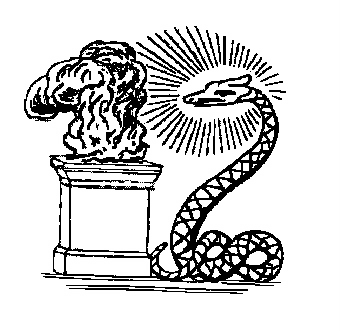
The Phoenician serpent god, alias Basilisk. The serpent, as well as the image of the sun, is always a phallic symbol in ancient religion. Basilisk is where the Roman Catholic Church got the name-- St. Peter's Basilica.


Basilisk

Etymology

The word originates from the Greek form basilískos (Greek: βασιλίσκος; Latin: basiliscus), which means "little king," "little prince," "chieftain," or "young ruler," from two components βᾰσῐλεύς (basileús, “king”) and -ῐ́σκος (-ískos, diminutive[3]).

Accounts

The basilisk is called "king" because it is reputed to have on its head a mitre, or crown-shaped crest.

en.wikipedia.org/wiki/Basilisk
 

I AM ALL I AM

Active member
Joined
Jan 29, 2022
Messages
232
Reaction score
45
Points
28
THE REALITY OF THE LAW
From the Etruscan Religion to the Postmodern Theories of Law

(Kairosz, Budapest, 2005.)

The study intends to approach the ontological aspects of law in three larger units.

The first part introduces the question of the reality of the law with the fundamental problem in the philosophy of law that is the duality of the state and the law. In course of this with a new point of view it enlightens the state-legitimating feature of the law and the state law-making nature, a peculiar ’chicken-and-egg’ phenomenon. The law as a will of the state takes certain ’Sein’-features as well, and the study shows that, in this too, the law differs from the basically ’Sollen’-type conventional and moral rules . The first part of the study also examines how much the description of the reality of the law is apt to be interpreted as a certain law-ontology.

The study points out that the complicated notion of the law – like all the other complex notions – is created in the course of experiencing, comes to existence ’a posteriori’, and the book also intends to draft the way how the law and its notion could take shape.

The first part concludes with expressing a doubt , namely, that how much the Western concept of the law and philosophy of the law could be considered as universal and authoritative concerning all the other laws and legal systems.

The second part searches the spiritual origin of the Roman Law, basis for the Western law. It points out that while the jurisprudence concernes the Roman Law as a basically profane structure compared with other legal systems, in fact the Roman Law developed from a certain religious environment. True, though, that it developed from a totally different religiousity like, for example, the ancient Eastern, Islamic or Far-Eastern religious world.

It was percepted by the history of the law about one hundred years ago, that the earliest Roman Law, especially its strict formalism can conserve fragments of certain religious ideas. However, the traditional research did not go further than merely mentioning this supposition. For the history of religion, likewise in the last century, it became more and more obvious that the Etruscan religion made the biggest impact on the Roman religion. Through connecting these two perceptions, the study proves that the ancient roots of the Roman Law derives directly from the Etruscan religion, which puts great emphasis on the rituality and is rather formality-centred concerning its nature. To prove this the second part of the book drafts the structure of the bi-rooted Roman culture (Etruscan and Italian origin), then it verifies its Etruscan descent through the description of certain phenomena and legal institutions.

The second part of the study results in detecting the religion-originated formality gradually dissolving and living on hidden.

The third part describes the Western law as a descendant of the religion-originated Roman Law and as a certain ideal parallel universe and also compares it with the Islamic and Chinese laws. Analysing the connection between the material and the subjective law the study, finally, tries to seize the notion of the law and through this the reality of the law as a particular idea-system at the same time highlighting the peculiar ’time-structure’ of the ideas. It is namely that the human conscience does not merely think about the purely assumed things existing only in the period of thinking but it perceives them as existing independently from the conscience.

The closing thoughts of the study also points out some questions in connection with the legal system of the Europian Union, a seemingly new-born authority.


I AM ALL I AM

Active member
Joined
Jan 29, 2022
Messages
232
Reaction score
45
Points
28
Owners of Empire
The Vatican, the Crown and the District of Columbia

.....
globalelite177_03_small.jpg

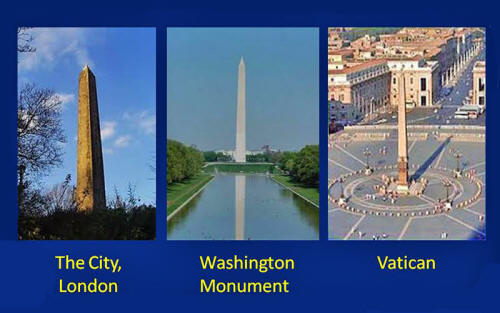
Located in the center of each city is an Egyptian obelisk erect.

They are:

- the obelisk in St. Peter's Square

- the Washington Monument

- Cleopatra's Needle in the City of London

Of course, one question you might want to ask yourself is why is there an Egyptian obelisk, which is a tribute to the Egyptian "pagan" sun god Amen-Ra, in the middle of Vatican City?

Contained within these three cities is more than 80% of the world's wealth.

The Empire of "The City" is essentially the British Empire, or more accurately, the forces behind the British Empire of the past. The Empire asserts its control over its colonies (such as the U.S., Canada, Australia, the European Union) through complicated means.

One of their means of control is to have agents of their cause in high places of influence.

This cabal of powerful manipulators is known collectively as,

- the Illuminati

- the Shadow Government

- the Omega Agency

- the Government within the Government,

...and so on. It does not matter what they are called.
.....
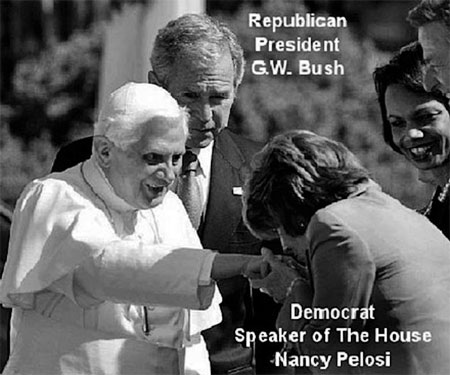
Empire States are "sovereign" - operating above all other nation states, whose installed leaders MUST make pilgrimage to Rome and do obeisance before their earthly king.

globalelite177_04.jpg
.....
In other words, the City of London (that is the square mile within Greater London) is not technically part of Greater London or England, just as Vatican City is not part of Rome or Italy. Likewise, Washington DC is not part of the United States that it controls.

These sovereign, corporate entities have their own laws and their own identities.

They also have their own flags. Seen below is the flag of Washington DC. Note the three stars, representing the trinity of these three city-states, also known as the Empire of the City. (There is also high esoteric significance to the number 3.)

So how are these three cities ultimately connected? We must first go back to the Knights Templar and their initial 200-year reign of power.

The Knights Templar were first called,

"the Poor Fellow-Soldiers of Christ and the Temple of Solomon."

This is a blatantly misleading title, considering the immense wealth and power of the Templars, who operated 9,000 manors across Europe and owned all the mills and markets.

It was the Templars that issued the first paper money for public use in Europe, establishing the fiat banking system we know today.

In England, the Templars established their headquarters at a London temple, which still exists today and is called Temple Bar. This is located in the City of London, between Fleet Street and Victoria Embankment. The aforementioned "Crown," to be exact, is the Knights Templar church, also known as the Crown Temple.

It is the Crown Temple that controls the legal/court system of the U.S., Canada and many other countries. All bar associations are directly linked to the International Bar Association and the Inns of Court at Crown Temple in the City of London

Anytime you hear somebody refer to the Bar Association, they are talking about a British/Masonic system that has nothing to do with a country's sovereignty or the constitutional rights of its people. This is why, when you go to court in the U.S., you see the U.S. flag with a gold fringe, denoting international rule.

The government of the United States, Canada and Britain are all subsidiaries of the crown, as is the Federal Reserve in the U.S.. The ruling Monarch in England is also subordinate to the Crown. The global financial and legal system is controlled from the City of London by the Crown.

The square mile making up the center of Greater London is the global seat of power, at least at the visible level.

Washington DC was established as a city-state in 1871 with the passage of the Act of 1871, which officially established the United States as a corporation under the rule of Washington, which itself is subservient to the City of London.

Corporations are run by presidents, which is why we call the person perceived to hold the highest seat of power in the land "the president."

The fact is the president is nothing more than a figurehead for the central bankers and transnational corporations (both of which themselves are controlled by High Ecclesiastic Freemasonry) that really control this country and ultimately call the shots.

Washington DC operates under a system of Roman Law and outside of the limitations established by the U.S. Constitution.

Therefore, it should not be a surprise that the name Capitol Hill derives from Capitoline Hill, which was the seat of government for the Roman Empire. If you look at the wall behind the podium in the House of Representatives, you will notice that on either side of the U.S. flag is the depiction of bundles of sticks tied together with an axe.

These are called fasci, hence the root word of fascism. This was the symbol of fascism in the Roman Empire, as it was under the Nazis and still is today. It is not a coincidence that these symbols are featured on the floor of Congress.

Most U.S. citizens believe the United States is a country and the president is its leader, but the U.S. is not a country, it is a corporation, and the president is not our leader, he is the president of the corporation of the U.S.
.....
City State of London is the world's financial power centre and wealthiest square mile on earth - contains Rothschild controlled Bank of England, Lloyd's of London, London Stock Exchange, ALL British banks, branch offices of 385 foreign banks and 70 U.S. banks.

It has its own courts, laws, flag and police force - not part of greater London, or England, or the British Commonwealth and PAYS ZERO TAXES!

City State of London houses Fleet Street's newspaper and publishing monopolies (BBC/Reuters), also HQ for World Wide English Freemasonry and for worldwide money cartel known as The Crown...
.....
The Crown is private corporate City State of London - it's Council of 12 members (Board of Directors) rule corporation under a mayor, called the LORD MAYOR...
.....
They are known as "The Crown." The City and its rulers, The Crown, are not subject to the Parliament. They are a Sovereign State within a State. The City is the financial hub of the world.

It is here that the Rothschilds have their base of operations and their centrality of control:

- The Central Bank of England (controlled by the Rothschilds) is located in The City

- All major British banks have their main offices in The City

- 385 foreign banks are located in The City

- 70 banks from the United States are located in The City

- The London Stock Exchange is located in The City

- Lloyd's of London is located in The City

- The Baltic Exchange (shipping contracts) is located in The City

- Fleet Street (newspapers & publishing) is located in The City

- The London Metal Exchange is located in The City

- The London Commodity Exchange (trading rubber, wool, sugar, coffee) is located in The City
.....
The Lord Mayor and 12 member council serve as proxies/representatives who sit-in for 13 of the world's wealthiest, most powerful banking families (syndicates) headed by the Rothschild Dynasty they include:

- Warburgs

- Oppenheimers

- Schiffs,

...these families and their descendants run the Crown Corporation of London

Rockefeller Syndicate runs American colony through interlocking directorships in JP Morgan Chase/Bank of America and Brown Brothers Harriman (BBH) and Brown Brothers Harriman New York along with their oil oligarchy Exxon-Mobil (formerly multi-headed colossus Standard Oil).

They also manage Rothschild oil asset British Petroleum (BP). The Crown Corporation holds title to world-wide Crown land in Crown colonies like Canada, Australia, New Zealand and many Caribbean Islands.
.....
The constitution for the District of Columbia operates under tyrannical Roman law known as "Lex Fori" which bears no resemblance to U.S. Constitution.
.....
The bulk of the ownership of the Federal Reserve System, a very well kept secret from the American Citizen, is held by these banking interests:

- Rothschild Bank of London

- Rothschild Bank of Berlin

- Warburg Bank of Hamburg

- Warburg Bank of Amsterdam

- Lazard Brothers of Paris

- Israel Moses Seif Banks of Italy

- Chase Manhattan Bank of New York

- Goldman, Sachs of New York

- Lehman Brothers of New York

- Kuhn Loeb Bank of New York
.....
Full article (including videos and clickable links) at ..... www.bibliotecapleyades.net/sociopolitica/sociopol_globalelite177.htm
 
Top